 SingFun
The Reverse Talking Challenge: How to Play It and How to Win
The reverse talking challenge is simple to explain and hard to do. You record a phrase, listen to it played backwards, then try to say that backwards sound out loud. Finally you reverse your own attempt. If you did it well, the playback sounds like the original phrase. It is also known as the reverse audio challenge or reverse singing challenge, and it is harder than it looks.
What you need
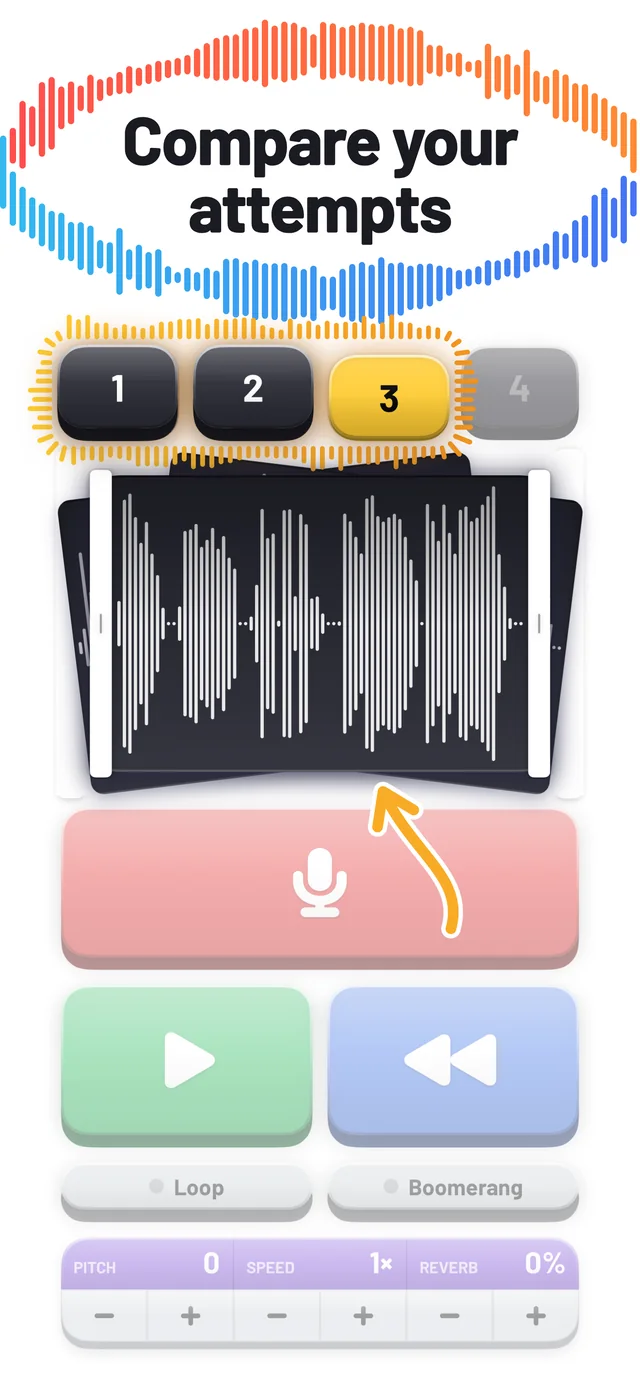
A phone with an app that can record and reverse audio, a quiet corner, and anyone you want to challenge. SingFun was built for exactly this, with numbered slots for the original and every attempt, so you can compare them with one tap. You do not need to be good at singing or at impressions.
The rules, step by step
- Record the original. Tap the red key and say or sing a short phrase, about two to five seconds. Anything works: a sentence, a name, a line from a song.
- Reverse it and listen. Tap Reverse. Play it five or ten times. Do not try to understand the words. Listen to the rhythm, the melody and how the sounds sit in your mouth.
- Record your attempt in a new slot. Switch to slot 2 and imitate the backwards sound. You are copying a sound, not saying a phrase.
- Reverse your attempt. If you did it right, you will hear something close to your original phrase.
- Compare and retry. Switch between slot 1 and slot 2 and see how close you got. Record again until it clicks.
Reversing your attempt is what turns the backwards noise back into words. The sound you made while imitating only needs to be the reverse of the reverse. That is why people laugh so hard: what feels like gibberish while recording can come out as a perfect phrase.
Tips that actually help
Choose the right phrase
Start with two to four syllables, such as a first name or "good morning". Long sentences are the expert level. Phrases with strong consonants like "t", "k" and "p" are easier to follow, because the clicks stand out even when played backwards.
Think sounds, not letters
Spelling gets in the way. "Name" is the sounds n-ay-m, and backwards that is m-ay-n, which sounds like "main". Reading letters in reverse only makes you slower. Our beginner's guide to talking backwards has a method that avoids this.
Copy the melody first
Every phrase has a tune, with the voice rising and falling. Backwards, that tune flips too. Hum along with the reversed audio before you add the sounds. Matching the rhythm gets you most of the way.
Do not slow down
If you pronounce each sound carefully, the reversed attempt will be too slow and choppy. Aim for the same speed as the backwards recording you heard.
Trim the silences
A second of quiet before your attempt starts will show up as a second of quiet at the end of the reverse. Use the two trim handles so you compare only the part with sound in it.
How to score it with friends
Here is a scoring system that works at a party:
- Three points if someone who has not heard the original can identify the phrase from your reversed attempt.
- Two points if the whole room agrees it matches the original.
- One point for a recognisable word or the right melody.
- A bonus point for the funniest failed attempt. There are always some.
Four slots on an iPhone let you keep the original and three attempts at once, which is enough for a round. For more formats, see our nine reverse audio games.
Try it with singing
The challenge works with a sung line too. Pick the chorus of a song that everyone knows, record it, reverse it, and see who can sing the backwards version best. Singing keeps the pitch, so you get a tune to follow, which makes it easier than speech for some people and harder for others.
Why it is so hard
Your brain recognises speech partly by how sounds start and fade, and reversing swaps that over. Understanding this makes you better at the challenge. We explain it in why reversed audio sounds so strange.